

-
New Year New You
So you are probably like me and no different to anyone else at the same time….What I mean to say is that in terms of the new years resolutions even though you know its an antiquated concept, you still at least in your head, if not out loud, make some new-you promises. Of course we tell the world that ‘no, I’m not doing resolutions this year’, just going to change this and that, oh and this other thing also, but then deep inside, we secretly tell ourselves that we’ll eat better, train better, go to bed earlier, drink less, argue less…. Basically do more good stuff and less bad stuff. Sound familiar? So why wait, the new you is waiting to emerge, all you need to do is click here…only kidding, but on a serious note, now is definitely the optimum time to get signed up to some self-improvement activities. At LFR you may have noticed that we are running a series of workshops on running form. Fix your form running form for 2016? Sadly its now full, but please check it out, ask questions, and perhaps you can let us know if you’d be interested in a session in the future. https://leightonfunrunners.org.uk/private-members-area/dynamic-movement/ Additionally you could register for the watchless series of races. What is that? Its a 5 mile race where you submit your predicted time in advance then, without a watch, try to run it as close as possible to your prediction, with a global objective of everyone finishing at 12 o'clock. The winner will be therefore the one who is the closest to their prediction and naturally finished closest to 12 o'clock. Register your time here for the 5 or 10 mile races. Better still, these are free for LFR members. https://leightonfunrunners.org.uk/club-activities/watchless/ Also key for any training plan is speedwork. This can come in many shapes and sizes and starting in the new year LFR is organizing a series of ‘fartlek’ speedwork sessions to kick start the speedwork training on Wednesday evenings. Want to know more? https://www.facebook.com/events/811792868946418/ Finally. You may be thinking about how to increase your mileage as part of your new year, new you plans. Well each week for a couple of months now we have been running weekend long runs. Between 10 and 20 miles in distance, the aim is to build up the distance ahead of the marathon season. https://www.facebook.com/events/456891747851743/ So as you can see there’s lots going on, LFR doesn’t stand still, so why not get involved in one of these programs and kick start your new you new year promises.
Continue reading -
Christmas Calories
So there’s no surprise. The food and drink have been consumed and the guilt has set it. Its that time of year again when most people get to the stage where all their clothes start to fit a bit tighter than normal. Apart from the lucky few exceptions that can eat what they want and never gain weight, balancing energy taken in as food/drink and energy expended as exercise is a tricky business. But why is that? How come its so hard for us to work out the energy content of what we consume and trade that off against some exercise? On Christmas Day the average person in Britain consumes about 7000 calories, although most people think that they are only consuming about 3000 calories! Hmmm, Just think about that…. Perhaps there’s some burial of heads in the sand going on? But that’s a separate problem right there, in the difference between the calories that people think they are consuming and those that they actually do. The average moderately active woman only needs 2000 ~ 2300 calories per day and an average moderately active male 2600 ~ 2800. Therefore it’s very clear why our clothes fit much tighter in January! Even if you try to burn that off, the average calorie spend per mile (running) is only roughly speaking 100, but there’s some other factors to bear in mind of course. But to put that into some sort of perspective, even a moderately fit male would have to run 40 miles just to break even on Christmas day in terms of net calories. When you break down how much exercise you have to do to counterbalance your calories consumed, you might be shocked. (http://www.nutristrategy.com/caloriesburned.htm) But where’s the fun in constantly trying to balance calories in and out? Is it not enough that we run, and try to enjoy some of what life has to offer? I try to take a balanced view. A few over here and a few under there, no point trying to keep track of much more than that if you lead an active lifestyle, but what I’ve found useful is trying to keep in mind just how few calories an exercise burns in reality versus what we think it burns and try to understand what sorts of calorie requirements some sports have. I said calorie requirements for a reason, as to take part in sport you need to be able to be able to spend calories, and so going the other way and not eating much, or not eating carb-rich food, could restrict your ability to partake in the sport. So as is always the case as we head towards January, we start to think about resolutions, and “going on a diet” must be near the top of the nations’ list. However, before going down that road, maybe stop to think about educating yourself with the link above about what the real calorie burn from exercise is, and this may help you make more educated choices, and is better than dieting.
Continue reading -

Why do we run?
My long run this week was a return to something I didn’t know I missed: Trail Running. Setting out for 13 or so carefree trail miles was fantastic. As soon as I got onto the trail, I could feel the sense of freedom of not being surrounded by cars, or bothering about pace. Just 13 carefree trail miles. In a way it reminded me of what I always liked about running, which is not thinking or focusing on anything, just running through the countryside, taking it all in, letting nature distract me. This made me think that sometimes we possibly lose track of why we run, or more importantly what it is precisely about running that we like. Lets be honest, running can hurt, we sometimes have to get up super-early to do it, and often go out in weather that others consider crazy. Its no wonder that more people don’t give it up. Running clubs up and down the country will have heard the question a million times over and runners spill out of the club into the cold, wet night… “why are we doing this”? Is it because of the targets we set ourselves? I must run a sub-4 marathon, for example. Not really, as all time based targets are kind of arbitrary, and after we complete one target another one comes immediately afterwards, almost like hitting the first target was not good enough. No, this is not the reason why we run, this is just a carrot we dangle in front of ourselves. What about for health reasons, like to loose weight? Well there are easier ways, and most involve dieting and exercise of some form, with the latter only partially helping. However this seems like only a transitory reason and not one to keep us running week after week on dark, cold and wet nights. There are gyms for this surely? Perhaps its true that the reasons why we run can change from time to time also. One week we might run to escape stress at home or at work, by freeing ourselves for the hour or so and emptying the mind. Other times we might run for companionship, or as part of a training program to get us to another carrot. Inspiration is another good reason to run, but not what you are thinking. Inspiring yourself. Each run will inspire you in some way and how often have you heard the phrase ‘there’s no such thing as a bad run’. The first person you have to inspire every day is yourself and running will do that. We're all terrible at something in life, so why not make up for it with a strenuous, completely unrelated activity? When you're nothing but a slob at the desk, you can instantly turn yourself around with a quick run. I've never been so low that a run wouldn't snap me out of it. There are no hiding places. Every run makes you fantastic. Once you stop, you're on your own, so it's a better bet to just keep it going. Why not take it a step further and attempt to inspire others not just ourselves? Running is not a private activity. People are watching. Show someone what it's like to want something. Lace up and give them something to believe in. So the truth about why each runner takes up and continues to run is that its probably for their own very personal reasons, but underpinning these will be a sense of joy…running must bring us joy. If it did not, then we simply wouldn’t do it. Joy found through running fast, or slow, on roads or trails. Joy found from escapism or from companionship; its largely irrelevant, the joy that running brings is why we do it.
Continue reading -
A Tale of Two Halves
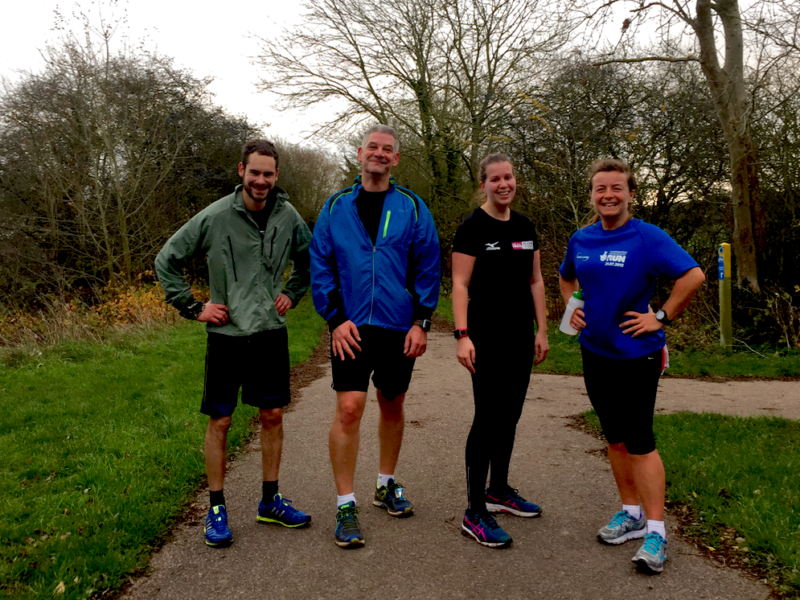
Saturday 14th November, the day had finally arrived. It was the Dirt Half. Now I had put in some fairly decent prep for it, although as always, it never seems enough. I’d driven to Stoke Hammond a couple of times and just attacked the hill – this slight incline, small undulation, tiny bump in the course, had become my nemesis from the previous year. So I made sure I was ready for it. Now the day was here and the weather was threatening to be wet and wild. Breakfast was eaten, I’d had the team photo taken (which ended up in the LBO) and I was nervously stood at the start line with Michael. The same Michael, who didn’t want to do Dirt Half again, however after much encouragement (bullying/harassing) excitedly signed up and trained with me. I kept telling myself ‘don’t go out too fast, don’t go out too slow’. But as always with these things, I chose to ignore my mantra and just run. I knew I had gone off fast when at four miles some of the really quick ones in my club started overtaking me…..I thought they’d be miles ahead. At 6 miles I was greeted by a lovely cheer from Glyn, and then it was down towards the hill. Now the speed of the last 6 miles plus the mental anticipation of the hill was started to make my legs and mind tire. I walked a bit, ran a bit, walked a bit….saw the photographer and was adamant I would at least appear to be running the hill if he was able to get a shot of me (which he did!) . The best thing about this hill, was knowing that there was a water station at the top, and along with it, a fantastic LFR cheer squad. They didn’t disappoint (thanks Max, Pam, Mariam and everyone else). They did however, give me a jelly baby. And about 10 minutes later I saw that jelly baby again. Note to self: stay away from the green ones! The rest of the run was torture, I’d made it half way, and knew I just had to finish. My feet were feeling battered, my energy levels depleted and I just wanted to cry. I’d made it out of the woods, across the water meadow and the slippery bridge, and just as I was coming up the slope towards the Globe I went down like a sack of spuds, I crashed straight onto my knee. My hands, legs and water bottle were covered in mud, and I literally wanted to cry. I plodded along the canal, and saw a rather encouraging Jim B shouting ‘come on Kelly, we saw you walking!’ Hehe! Yes, those last two miles were a lot of walk/run. I could feel the blisters and the pain in my toes from my soggy wet feet. Then I saw my husband, mum and son cheering me on at Tesco’s. It was just the boost I needed to get me through the final 1.5 miles. Another overhead cheer from the Mentmore Park canal bridge from Dave and Christine, I’m almost there. I made it up the last slippery, muddy hill. It wasn’t an award winning time, I knew it wasn’t. It was tough and it would have to just be another lesson learnt, I turned into the final straight and wait……what is that….the clock is there….2.23. It’s a PB! Yes I’ve got myself a PB! In fact my finisher’s time was 2.22.48, a 5 min half marathon PB and a whopping 12 min off my previous Dirt Half effort. I was absolutely thrilled! Three weeks later, it’s Sunday 6th December. Storm Desmond has stopped by to see us and I’ve got an undulating Bedford Half in my sights. I’m nervous about this one. Exactly one year ago, I was all set to do Bedford Half, however the day before was admitted to hospital with suspected appendicitis. Thankfully it wasn’t, however this has led to a year of blood tests, scans, x-rays, numerous doctors and consultant visits, daily medication, changes to diet, lots of pain and upset, and I’m still undiagnosed and under consultation. I’d picked up my number, the team photos were taken, and I’d waved goodbye to my family. I’m about to set out on 13 miles of a route I don’t know, but I know the area so knew the hills were going to be challenging and the wide open country roads would mean Storm Desmond would be a hindrance. First two miles felt good, got into a nice stride, then there was the first hill. I haven’t even completed a 5k and I’m walking! This is quite soul-destroying. I plodded on. At six miles, I saw my family. I felt defeated. I thought I was letting them down because my head wasn’t in the race and neither was my body 🙁 I could feel a blister under the bruised toenail (courtesy of Dirt Half) on my right foot and it was playing on my mind. Then I saw two very special people – Mick and Phil (http://micknphil-marathonlads.com/about.php) . Mick glided past me pushing his son Phil in a wheelchair. You can read their story in the link above. I don’t have cerebral palsy – I have a blister. I’m not pushing a wheelchair – I am dragging me (down!). I took a couple of man up pills (Lucozade jelly beans – other fuel sweeties are available) and cracked on. I saw my halfway time – it was like a blow to the stomach – 1.06.50……then it became a maths run. Take a minute off for getting across the line…so 1.05.50, PB is 2.22.48. I can afford to do the same again this second half plus an extra 17 minutes to spare……what will that be if 10 min/mil, 11min/mil, 12min/mil….grrrr I’m frustrating myself. Eight miles gone, I stop for a walking break then I hear the words….the familiar sound I’ve heard at the last few cross countries, the Ampthill Trophy, the Dirt Half……’Come on young lady, even if you jog, keep moving.’ I don’t know his name. He runs with Bedford Harriers and he kicks me up the backside every time! Thank you! Five miles to go and the beans have kicked in. In fact miles 9-10 were fantastic. A lovely long downhill section and a sub 10 min/mil. At mile 11 I’m handed a cup of beer. I politely decline and hand it back. Could’ve done with that at the end 🙂 Saw my family for a split second as I ran past. Back on form! I’ve got this. The last hill climb through Wootton to the finish line was horrible. All the runners who had already completed their races were wearing their finishers top walking back down the hill towards the coaches. My family were just approaching the finish area, I grabbed my sons hand and he finished the last part of the race with me. I turned that final corner and saw some numbers I just couldn’t believe – 2.18.20 – another PB! My final time was 2.17.48, a huge 5 min improvement on the last race three weeks prior. I’m on cloud nine, absolutely over the moon! And really really looking forward to Milton Keynes Marathon – who knows that elusive sub 5 hour marathon might just be in my sights!
Continue reading -
Running Technology
We all know that its good not to run too many miles in single pair of running shoes, most having a life-expectancy of between 300 and 500 miles, with many factors affecting the actual longevity of the running shoes, such as the running gait, your weight, terrain and so on. Running in shoes that have done way too many miles can be detrimental to you as the foam and rubber break down, their elasticity disappears, and even though the shoe may appear to the eye to be in good condition, it could be potentially completely finished from a running perspective. Running in shoes like that, forces you to adopt a less perfect running style, which for a few miles may be ok, but over time, can be a problem and lead to injury and who wants that? I was reminded about a pair of running shoes reaching a certain mileage this week by a piece of technology. On the face of it this may not seem so exciting at all, I mean, you hit 400+ miles in a pair of running shoes and its not exactly a reason to party but all the same it makes you think…this is exactly how technology should be helping us. Often we hear about science and technology and the next ‘big breakthrough’ and two things always sprint to mind. (1) wow that’s cool and (2) How the hell is that supposed to be useful to someone… Often it’s the case that we are fed a diet of technology for the sake of technology, where the usefulness is completely moot, but in this case, for once, technology actually provided tangible benefit. When you stop to think about it though, as runners we are surrounded by technology, from the watches on our wrists to our specialist wicking gear and from the specialist head-torches to the myriad of sports related social media sites we use, but how much if it is truly useful? Taking a deeper look at just how much tech we are surrounded by and you could even be forgiven for saying that as runners, we’ve never had it so good. The gear is lighter than ever, its more waterproof, the batteries last longer, the beam of light is brighter, its more supportive or even the case of the Apple iPod Nano it allows us to carry entire catalogs of music around with us in a package that weighs a couple of grams, whereas at one point not that long ago it would have been a bulky device that permitted 10 tracks or so. But what technology is useful and what is superfluous? Its often said that running is a cheap sport, all you need is a pair of trainers and you can go! Well this is true to some degree, in the same way that to practice swimming all you need is to jump in the river….at some point you may want goals, and gear that enable you to become better at the sport, or you may not. This is the beauty of it. However, technology that enables you to enjoy a sport more comfortably, or helps keep it injury free, this is technology worth having, such as quality waterproof jackets and decent running shoes. Do we really need compression gear? 100,000-track music catalog? What about expensive mineral and vitamin-enriched drinks? Expensive gels? The answer is that some tech is genuinely very useful for all runners and some tech is momentarily cool, with the benefits being somewhat debatable. The feature I was taking about that tells you when your running shoes ‘might’ need changing is on Strava. www.strava.com and I consider it very useful for two reasons. Firstly, as humans, we forget things and secondly we are lazy. Take any pair of running shoes you’ve owned….how many miles have you done in them? Yeah exactly…you’ll never know. So to have a piece of tech seamlessly take the data from your watch, count your miles, then remind you when its time to change….this is worth having! So, if you’re not already on Strava, yet another reason to get yourself on, and join the club there.
Continue reading -

Running on Empty
There was a time when nobody really paid much attention to nutrition within the running world. Performances were defined by ability, not by advantage gained through race-based or training-based nutrition plans. Today of course the world is a different place. Nutrition is a word that more people are familiar with, at a minimum most people within the running community will be aware of the concept of carbs, carb-loading and that poor nutrition can negatively impact performance…but to what extent? There certainly is a lot of information on the Internet concerning diets and nutrition for runners, but is there too much? The plethora of information available can sometimes be confusing, however there are essentially three types of training a runner might undertake, and each will have its own nutritional demands; • Hard training days and race days• Moderate intensity training days• Light training days, cross training or no training Hard daysOn these days, carb intake needs to be higher than normal to meet the very physical demands for energy, and a serving should be included with all main meals. This doesn’t mean, as is often thought, stuffing yourself with carbs at every meal. The portion sizes need to stay the same, but the ratios of carbs/fats/proteins needs to change. Snacks can also be used to boost intake to support high training needs. A low GI breakfast will provide sustained energy during the morning and for a longer run. The increased carbohydrate intake means you should aim to limit fat, but a moderate protein intake should be maintained with each meal. Including an evening meal or snack containing protein is important to help your body recover from a heavy training day and assist muscle growth overnight, as this is when the majority of adaptation will occur. Increase fluid intake to compensate for sweat losses during training and stick to tried and tested foods before setting out on a long run. Regular training daysThe target is to moderate carbohydrates on these days, which would include a serving of carbohydrate at breakfast and lunch only, mainly to fuel training and replenish muscle glycogen stores. Intake can then be reduced in the evening. Meal options should focus on slow release carbs for sustained energy release. Aim for a moderate protein intake as well, a serving of protein should be included with each meal for ongoing muscle growth and repair. Include polyunsaturated fats in your evening meal to promote the function of muscle cells. Foods containing iron should also be included in three meals per week, which is vital for carrying oxygen to the working muscles and supporting energy production during endurance exercise. Low intensity daysCarbohydrate intake should be lower, due to the reduction in training volume. This may mean that only one meal needs to be carbohydrate based. This reduction in training gives the flexibility to use a protein-rich breakfast, which can reduce hunger for the rest of the morning. Intakes of protein from meals and snacks should be high on these days to support ongoing muscle tissue growth and repair in the 24 hours following a heavy training day. Bacon and eggs anyone? So when thinking about a training plan, think about how you can maximise effectiveness with some good nutrition choices also. Perhaps it also makes sense to think about a nutrition plan to go with it.
Continue reading -
First Cold Snap
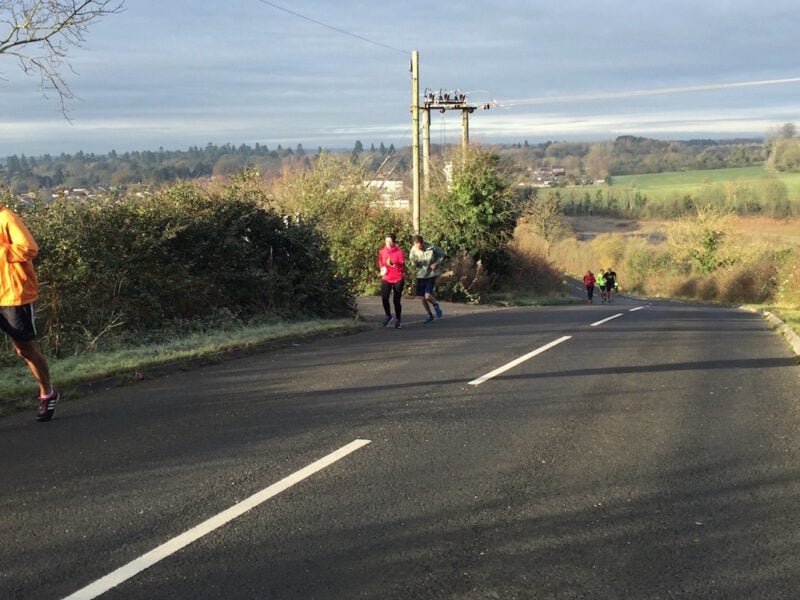
It’s a terribly British thing to talk about the weather. As a student I remember some foreign students laughing about how many people they hear talking about the weather in the UK, which wouldn’t be so bad if it was exceptional for the season, but mostly it was par for the time of year. However, as a runner the weather is a pretty important subject if you don’t want to mess up on a long run or race. Today we hosted a 10mile weekend long run with extra miles to make it up to 14 for those that wanted it. Given the kick-off time of 8am from the clubhouse, most people, myself included, would have put their kit out the night before. This would have been fine had it not been -2°C when I went out to the car. The shorts and T-shirt I’d put out the night before were simply not going to be enough. Time to grab the fleece jacket and gloves. Of those that ran, some were too cold, some were too warm and most didn’t have fluids. So what do we need to keep in mind about the cold weather? The most obvious point concerns the extremities. Cover them. I used to think that as long as you are running, you’ll stay warm enough for it to not be an issue, but that’s completely flawed of course. If it’s cold enough your extremities will simply stay cold if not covered. I learned that the hard way in the South African winter, foolishly assuming it would be warm, only packed shorts and t-shirts to run. The -5°C mornings were just too fresh and it was impossible to maintain heat and my fingers and ears were like ice no matter how long I ran. So in winter, hats and gloves should be definitely in the kit left out the night before. Hydration is another point worth thinking about. When its cold your body works harder than in warmer weather by having more work to do maintaining body temperature especially, if the air is dry also. Just because its cold, however, it doesn’t mean that you don’t sweat. You do, and you loose water and salt through sweat at a greater rate. A lot of runners neglect hydration in winter, possibly thinking that if its cold that you will sweat less. So, remembering hydration in cold weather is key to being able to comfortably complete the runs. Clothing is also very important, especially taking into consideration the fact that you will sweat, therefore wicking sport materials are important if you want to be comfortable. The general advice seems to be put layers on. The ‘base’ layer should be a lightweight wicking top, then depending on the weather either a second layer of fleece or rain jacket. If you get too warm the second layer should be packable or you should be able to tie it round your waist. Chilling is something that we all like to do, but not when its -2°C and you are cooling down rapidly. During the run, keep the regrouping as brief as possible to avoid cooling down too much, and when the run is over its important to change quickly out of the running gear and get warm again.So there’s really no reason to stay inside and skip your run when its cold or when the weather turns bad. There is a famous Scandinavian saying “Det finnes ingen dårlig vær, bare dårlige klær” which in Norwegian means “there’s no such thing as bad weather, only unsuitable clothing”, which is definitely appropriate to us runners.
Continue reading -

Running and Mood
Recent events in France remind us all how stained the world is and how difficult life will be now for people directly affected by such atrocities. Lives never the same again, but because of the way the world is connected these days, the ripple effect of such emotion cascades quickly, spreading around the world in no time at all. It’s hard not to be affected, but we just get on with our lives, and we store the images and sounds in the part of the brain, filed under ‘dark stuff’ and move forward. Perhaps we change our Facebook image in disgust, and then we get about our business. As we go about our daily lives though, we sometimes unwittingly become stressed over seemingly trivial things, never really being able to pinpoint what it is that bothers us, or if so, why. Is that in part due to an accumulation of negative imagery overloading our senses? It’s just part of life, we shrug the shoulders, say something like, “I’m ok”, and get on. But what does any of this have to do with running? You often hear people say things like “You will never feel worse after a run” and “Go for a run to clear your mind”, but surely that begs the question of whether running is good for your mind, and if so what is the link between running and state of mind or mood. Much has also been written about the benefits of exercise and specifically running for health and physical wellbeing, but the links between mental health and running are harder to prove and also harder to find unequivocal empirical evidence on. Perhaps the complex nature of mental health and also the taboos that surround it do nothing to assist that. A quick glance at the internet will give you an idea that running is good for your mood, but how and to what extent? Perhaps, just as the mind is such a complex personal space unique to each and every one of us, could the possible ways that running is good for the mind therefore be as equally unique and diverse at the same time? What I know is that after I run, I tend to feel mentally refreshed. I was once asked what I think about whilst out running on long runs, and the answer is everything and nothing. How can that be? The run starts with a thought process, which leads to another thought, and so on, all of them colliding into one another, until they sort of merge together in a thought-soup. Sometimes there are eureka moments but mostly not, but I think that this jumbling of thoughts and ideas is a way of distancing ourselves from reality for the duration of the run, like the emptying of a bath: everything that was stored is released. Ask someone after a solo run what they thought about…it’s hard to pinpoint something and provide an answer, everything and nothing. This is potentially why we feel ‘refreshed’ after a run, by allowing all the stored thoughts to bounce about in our mind until they slowly release their energy and become spent. Physically drained, mentally restored. This much is true for solo running, but even group running can be beneficial too. You go out on a long run with a few like-minded people and immerse in chit-chat and jibber-jabber and the miles fly by. It’s such a massive distraction from reality and this distancing from reality, or escapism, can provide valuable breathing space for some, which in itself can help to promote a calmer mental state. There are many scientifically proven things that happen to our bodies that influence our mood, such as the release of endorphins, which lead to what is described as ‘Runners’ High’. Endorphins are painkillers produced in response to physical discomfort, according to Matthew Hill, Ph.D., an assistant professor at the University of Calgary's Hotchkiss Brain Institute. That doesn’t mean that you need to be in pain from running to feel the effects of endorphins, a ‘challenging’ run will produce this effect according to his research. What effect does the release of these endorphins play on our state of mind then after a run? The effects linger for a while and this too can explain why a ‘mood lift’ can be felt. This weekend I asked someone after the Dirt Half how they felt just after finishing….’I feel great’ was the answer, despite the obvious physical discomfort. Mental illness notwithstanding, our mental ‘wellbeing’ is not something that we really think about. It’s like sitting in a room where the ambient temperature is perfect for us. We have no reason to think about it because we are neither too hot, nor too cold. Same goes for how we feel, we never stop to say….oh, I feel average today, only when our mood tips the scales at one end or the other do we notice. However does that mean that running can only benefit those under some sort of mental strain? I would disagree. Whilst it may be difficult to describe why or how running is good for our mood, and certainly more troublesome to categorically prove that, what I do know, is that running nearly always helps me feel mentally restored, whether I thought I needed it or not.
Continue reading -

Marathon Training and Real Lives
It’s getting to the time when people who are taking part in a spring marathon will start to think about their training schedule. When to start - Now? December? January? How many long runs? How far will the longest run be? No matter what the answers to those questions might be, a lot of people fall down before they even start the first run by failing to put any safety margin within their schedule. Well, have you ever had a cold? Got family and kids? Work? Basically, 4 months through winter is a long time to go without getting a cold. It’s also a long time to go without family and work constraints taking over. A lot of people try to ramp up the mileage too quickly and then pick up injuries. This can also put pressure on the training plan, compounding the issues. So anyone planning 16 weeks of training with no flexibility is definitely planning to fail, not planning to succeed. Factoring in some time to accommodate family and work related constraints and health issues is key. So how much flexibility do you need? There’s no simple answer to that. Ask yourself whether you can definitely commit to running big distances every single weekend in addition to running 3 or so times during the week. If not, try scheduling only 3 out of 4 of the weekends, leaving yourself a free weekend every month. This of course will mean that your overall plan will be longer, meaning in turn that you will need to start it sooner. That’s ok, it is also better for your body to ramp up slower and should help reduce injury risk in the process. But, there are other things you can do to free up time, combining running with other things. Running to pick up the kids, running to work, running on your lunch break…. all good options for fitting training into busy lives. The key is prioritisation. If the marathon training is important to you despite your busy schedule, it makes sense to try to work out how that stacks up against other demands on your time. Be creative and think more about quality of the runs in your plan, and not the quantity. Focusing on quality will give you the confidence to feel ok when, ultimately, you need to drop sessions. Sometimes, the temptation is to try to replace a missed session as soon as possible in the schedule. This can be a bad move, adding additional strain where ordinarily you were planning a break. Being flexible enough to re-arrange runs for the week can be a better approach. Understand that a missed day is the same as an extra rest day and that rest is a key component of the training plan. It’s inevitable that you will miss some sessions in your training. Planning ahead and making allowances for this up front will help you get through the training with lower risk of injury, better physical condition and greater confidence. Perhaps of the three, going into the race with a good level of confidence is the most important. A lot of people get through the physical training but don’t work on their confidence and the mental demands of the race – but that’s another topic. Getting to the start line in good physical condition, with confidence, takes time and good planning and so if you are about to start your marathon training soon, take some time to think about whether you have enough flexibility in your plan. It could make all the difference on race day. See also Planning for marathon success.
Continue reading -

Speed & Stamina – Is it for me?
Every Thursday evening LFR organise a training session for all members – Speed & Stamina (S&S), but what exactly is it and is it for you? Here we answer…
Continue reading


